Out of Africa -> into the outhouse
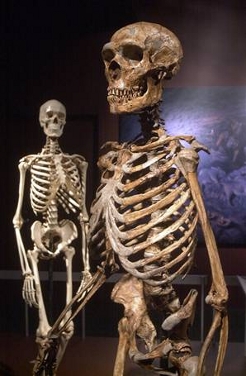
Around May of 2010, the Out-of-Africa (OoA) hypothesis was decisively refuted. [1] One consequence of the OoA hypothesis poses the complete replacement of Neanderthals in regions, colonized by Homo Sapiens - after their expansion from Africa (100-65Kyr). Any detectable trace of Neanderthal genes, found in current human populations, requires a modification of the theory. The assimilation of Neanderthals into the Homo Sapien population during (or after) the exodus of humans from Africa sharply collides with the OoA hypothesis.
With ground-up bone fragments (about the mass of a pill) extracted from 3 Neanderthal females - whose remains were recovered at the Vindija site in Croatia, more has been learned through genetically sequencing Neanderthals, than by studying them in the fossil record. To science, Neanderthals stretch back to 1856 - when the Feldhofer Grotte yielded the first Neanderthal remains - a skull-cap and some bones.
The bones from the Vindija cave fall within the range of 38-44Kyr. Neanderthal DNA appears to be packed into the human genome randomly, suggesting that it did not confer survival advantages on modern humans. (Update: see the following footnote [2]. ) Interestingly, no evidence for gene flow was found, traveling in the opposite direction - from Homo Sapiens to Neanderthals. This fact might be accounted for - if the interspecific, "love-fest" in Europe occurred between small, invading wavelets of modern humans and a large, settled population of Neanderthals (or between a wave of modern humans whose population-size was expanding and a resident population of Neanderthals whose population-size was contracting). The lack of human genes in the Vindija females' bones could - also - have been a circumstance of their times. Modern humans may not have arrived in their vicinity (present-day Croatia) ~40Kyr ago.
Following the dispersal of Homo Sapiens from Africa, the evidence is that Homo Sapiens and Homo Neanderthalensis interbred. In present-day non-African population groups, a 1-4% contribution of Neanderthal genes has been identified. (Update: In Jul 2013, a new estimate of the Neanderthal contribution puts it at: "3.4 - 7.9" percent.) [3] In the present-day African population, there's an estimated, statistically significant non-zero percent of Neanderthal genes, indicating small, episodic flows of Neanderthals (or back-flows of hybridized humans) from Western Asia into Africa. (There has never been a convincing Neanderthal site unearthed in Africa.)
For decades, tantalizing clues pointing towards assimilation have been advanced, yet nothing compelling came about to cinch the case - until relatively recently. Some calculations ran that it would have taken only one absorption of a Neanderthal individual every other generation into the Homo Sapien population (over a period of about 10Kyr) for Neanderthal genes to become detectable in current human populations.
In 1997, Wolpoff and Caspari identified Neanderthal, non-adaptive traits in Europeans - which cannot easily be reconciled with OoA. At the time, Wolpoff's and Caspari's evidence (a summary below) was dismissed and/or deemed "fragmentary".
"There is also regional continuity in nonadaptive features. Nonadaptive features can persist after they are established at high frequency, when no evolutionary forces act to change them significantly. Because of their nature, they are very unlikely to persist if the history of a region is marked by population replacements. One of the best arguments for a significant European Neandertal input into the gene pools of later Europeans is the persistence of nonadaptive traits. Features such as the shape of the hole for the mandibular nerve to enter the mandible, or the presence of a small bump on the outer edge of the femur shaft, near its top, are difficult to explain any other way." [4]
Wolpoff's evidence that humans and Neanderthals interbred in Europe was blamed - not the OoA theory itself - which excludes any possibility of interbreeding. In 2002, Eswaran identified - what have been termed - "non-bottle neck traits" in humans. [5] According to the OoA hypothesis, the entire human population experienced a constriction after leaving Africa. Its genetic variation shrunk-down to the aperature of a capillary - which rules-out the possibility of "non-bottle neck traits" being found in human populations. The Human Genome Project, a great scientific achievement, linked no more than 90% of existing human mtDNA and Y haplo-groups to the population that spread out from Africa 100-65Kyr ago, revealing another possible discrepancy between solid, genetic evidence and the OoA hypothesis.
I'll not rehearse anymore older, confounding evidence against OoA here, but suffice it to say that its demise was smelt drifting palpably in the air for some time, and - in retrospect - why it attracted such a long-term, almost fanatical adherence might best be explained that it is an idea, resounding with a politicized knell of "truth". Over time - if possible, when counter-evidence against OoA mounted, its acolytes became more and more "hardened" towards its invincibility. [6]
On the face of it - and from the outset (1985), the OoA hypothesis was - almost uniquely - susceptible to refutation. It's a greedy explainer. Plus, the OoA is constructed on top of a universal negation. Under it, no present-living human can trace any portion of his ancestry to a population - other than the one, which radiated from Africa 100-65Kyr ago. Any detectable amount of interbreeding between humans and Neanderthals blows this universal negation to shreds. The analysis of the Vindija bones blew it up. Simply put, OoA cannot countenance evidence of assimilation, surviving intact.
John Hawks expressed it best -
"From now on, we are all multiregionalists trying to explain the out-of-Africa pattern."
Notes
(1) In paleoanthropological argot, the phrase for the OoA hypothesis is the "Recent Single-Origin Hypothesis". "Single-Origin" refers to the exclusive African origin of modern humans. Evidence of interbreeding (found in current human populations) between modern humans and any other hominid species on one other continent yields a "Recent Dual-Origin Hypothesis".
(2) However in Science August 25, 2011: As a result of our ancestors' interbreeding with more than one non-human species, the immune systems of modern humans were "invigorated". Two extinct species (Neanderthals and Denisovans) have been shown to have contributed HLA variants to modern humans. These HLA complexes "strengthened" the capacity of the human immune system to resist infections, and they increased the "viability" of the human genome. This study refutes a once widely-held notion that interbreeding with archaics conferred no survival advantages on modern humans. Furthermore, DNA studies of Neandertals and Denisovans suggest that these two species - together - account for ~7.5% of the ancestry of modern Melanesians. Denisovan FAQ
(3) Maximum likelihood evidence for Neandertal admixture in Eurasian populations from three genomes (2013), by Konrad Lohse and Laurent A. F. Frantz
"[] we infer a larger fraction of Neandertal admixture (3.4% > f > 7.9%) than previous studies (1-6 % [])"
(4) Wolpoff, M. and Caspari, R. (1997) from Race and Human Evolution, A Fatal Attraction
(5) Vinayak Eswaran (2002) from: A Diffusion Wave out of Africa: The Mechanism of the Modern Human Revolution?
"Not all genetic studies show signs of bottlenecks. For example, proteins, blood groups, and alleles of the major histocompatibility complex (MHC) loci show non-Africans having a genetic diversity comparable to and often greater than that of Africans (Takahata 1995). The presence of numerous ancient alleles at the MHC loci has been interpreted as suggesting that no population bottlenecks may ever have occurred in human and hominoid evolution (Ayala 1995). Other genetic systems too do not carry the bottleneck-and-expansion signature seen in mtDNA and at some other loci. These contrasting indications from different genetic studies need an explanation, particularly because the presence of bottlenecks has been construed as supporting a replacement scenario for the modern transition. I will now show that the dichotomy in the genetic data strongly suggests that assimilation from archaic populations occurred during the modern transition."
"Assimilation explains why proteins, blood groups, MHC loci, etc., show no signs of an Out-of-Africa bottleneck. Thus, the empirical fact of the absence of bottlenecking in ancient polymorphism implies that assimilation, not replacement, is the best explanation of the genetic data."
- my note
- In "A Diffusion Wave out of Africa", Eswaran spins a lusty tale of extensive human and Neanderthal Ice-Age sex-cavortin'. He whips-out Wright's "Shifting Balance" model to theorize how the "co-adapted genotype", arising from human and Neanderthal interbreeding, had a "selective advantage" over human (and Neanderthal) non co-adapted genotypes. He contends that a decline in infant mortality was the selective advantage - which contributed significantly to a population expansion among hybridized humans. However, Eswaran substantially overestimated the level of interbreeding, and his theory is evidentiarily weak.
(6) Milford Wolpoff, Alan Thorne and Roger Lawn (1991) from The case against Eve
"In Europe, long thought to be the best source of evidence for replacement, the fossil record offers equally little comfort to Eve's supporters. The evidence points to much mixing between the invaders and the native Neanderthals. According to our own analysis, many features once thought unique to Neanderthals lingered on among later Europeans. Only a few Neanderthal features disappear completely from the fossil record with the demise of the group as a whole."
- Further reading
- Wolpoff's collected papers
- A Diffusion Wave out of Africa - Vinayak Eswaran
- John Hawks blog
- The Origin of Us - video